
I have had early access to API Forensics’ Exponents. I have been testing these “X-tensions” for some time now. X-tensions are, in effect, add-ons to expand functionality with X-Ways Forensics. As usual, when I am asked to look and test yet-to-be released software, I tell no one until I can. So here I am telling you!

There are quite a few free X-tensions available online and several commercial X-tensions. You can even write your own with a little elbow grease. I’ve written a few, but nothing of any substance than to do a little thing or two that I need in casework.
But with API Forensics’ Exponents, this is an entirely new level of X-tensions. X-Ways Forensics just got a capability boost in a big way.
TL:DR
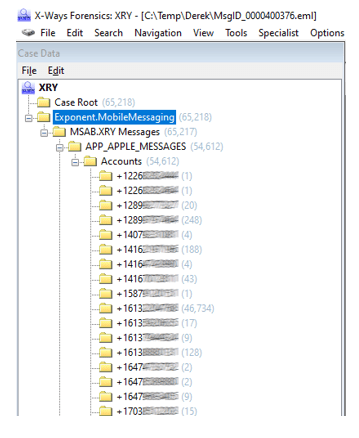
API Forensics Exponents allows XWF to easily ingest data from sources like video/pictures from mobile devices, cloud webmail (Microsoft, Google, Yahoo, Zoho, AOL, etc..), and text messages from 3rd party acquisition of mobile devices, along with a Facial Recognition exponent.

My favorite forensic software application is….
…whatever works for when I need it. Yes, I’ve now written two books on how to use X-Ways Forensics, but that was because I felt that XWF users needed more than the documentation provided by X-Ways. I think that I was right about that.
No, I do not only use XWF. I use anything and everything under the sun if the tool does what it says it can do and it solves for what I need. I will never promote a bad tool, nor complain about a bad tool other than sending a message to the developer directly. If you see a tool promoted on dfir.training or anything that I write or say, that means I personally endorse it.
But I do use XWF as a primary tool and as a validation tool to for different tools that I use as primary tools. It all depends on the type of case (data, device, OS, objectives, time, etc…) that I choose which tool will be my primary for that particular device or data examination.
The biggest negative with XWF is what it doesn’t do as well (or do at all) as other tools, like encryption. For those instances, I am exporting the data out of a XWF case for analysis with another tool that is better suited for that data. Yes, other tools are “better” than XWF in specific instances just as XWF is “better” than other tools in specific instances. I even wrote about this in the XWF books, noting that XWF even has a feature just for this purpose.

Back to API Forensics
And this is why I find API Forensics to be really cool. It gives XWF features that I wanted XWF to do in the first place, reducing redundancy in exporting data to yet another tool that needs yet another tool to validate.
Do I recommend this tool?
If you are examining the type of data that API Forensics supports AND you use XWF, then absolutely I recommend it. I am assuming that you are already competent in XWF if you have a license (and read my book!) so the learning curve is barely anything for the features you are adding in XWF.



 The X-Ways Forensics Practitioner's Guide/2E